Producing Cow Manure Biofertilizer Pellets Using a Disc Granulator

Cow manure is one of the most widely used raw materials in bio organic fertilizer production due to its balanced nutrient content and high organic matter. To improve handling efficiency, storage stability, and market value, many producers choose to convert composted cow dung into uniform fertilizer pellets. Among different granulation methods, the disc granulator, also known as a pan granulator or disc pelletizer, is a practical and flexible solution.

Why Disc Granulation Works Well for Cow Manure

After aerobic composting, cow manure typically becomes a fine, semi-dry powder with moderate moisture content. This physical condition makes it suitable for wet rolling granulation, which is exactly how a disc granulator operates.

Inside the rotating disc, raw material particles continuously roll and collide. With controlled moisture and rotation speed, fine particles gradually agglomerate into round pellets. Compared with extrusion or dry compaction, disc granulation offers:

Good control over pellet size

Smooth and uniform granule appearance

Lower mechanical stress on organic materials

These advantages make pan granulation technology popular in small to medium-scale cow manure biofertilizer plants.

Typical Process Flow for Cow Manure Pelletizing

A standard cow manure biofertilizer granulation process usually includes:

Composting and fermentation of fresh cow dung

Crushing and screening of composted material

Disc granulation with moisture adjustment

Drying, cooling, and screening

Final packaging

The disc granulator acts as the core pellet-forming unit, while upstream and downstream equipment ensures stable production and consistent quality.

YUSHUNXIN can provide you with not only disc granulators, but also complete cow manure bio-fertilizer production equipment. Welcome to consult !

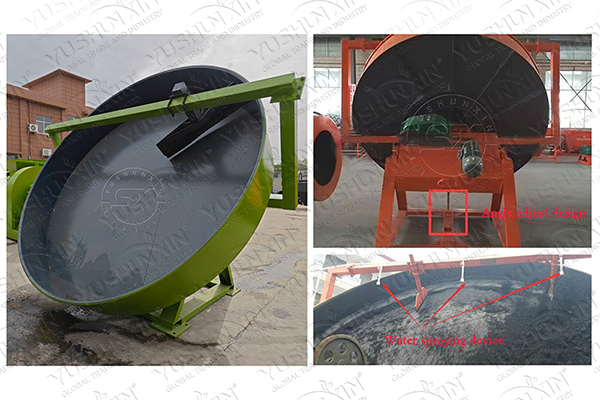
Adding Beneficial Microorganisms via Spray System

To enhance fertilizer functionality, many producers add beneficial microbial agents during the granulation stage. A practical approach is installing a spray system above the disc granulator.

This spraying device evenly applies liquid microbial inoculants, bio-enzymes, or nutrient solutions onto rolling pellets. Compared with dry mixing, spraying offers better distribution and adhesion, while avoiding excessive moisture accumulation.

Proper control of spray volume is critical. Excess liquid may cause pellet deformation, while insufficient spraying can lead to uneven microbial content. When correctly adjusted, this method helps produce biofertilizer pellets with active microorganisms and stable structure. Learn more!
Key Operating Factors to Watch

For stable disc granulation of cow manure fertilizer, operators should pay attention to:

Raw material moisture (usually 25–35%)

Disc inclination angle and rotation speed

Uniform feeding rate

Spray system consistency

Fine-tuning these parameters improves pellet roundness, strength, and yield.

Final Notes

Using a disc granulator for cow manure biofertilizer pellet production combines simplicity with flexibility. With the addition of a spraying system for microbial agents, producers can further enhance product value without complicating the process.

For those planning a cow manure biofertilizer project, understanding disc granulation principles and equipment configuration is a key step toward stable and scalable production. If you want to know more, welcome to visit: https://www.biofertilizerproduction.com/product/disc-pelletizer-for-biofertilizer-making/

What Makes Disc Granulation the Preferred Method in Mineral Fertilizer Production?

Mineral fertilizer manufacturing relies on advanced granulation processes to convert fine mineral powders into uniform, durable, and easily handled granules. The use of rock-based raw materials such as phosphate ore, potash, dolomite, limestone, and gypsum requires precise control over particle size, moisture, and density. Among all existing granulating methods, the disc granulation process stands out for its high efficiency, flexible operation, and adaptability to various mineral fertilizer formulations. The following analysis explores why this method achieves such wide acceptance in modern mineral fertilizer production and how industries benefit from it.


Raw Materials in Mineral Fertilizer Production: How Do Different Minerals Support Industrial Needs?

Mineral fertilizers use a broad range of mined raw materials, and each mineral brings distinct value to the final product. For instance, rock phosphate serves as a primary phosphorus source in phosphate fertilizer production, while potash ore contributes potassium for NPK formulations. Dolomite and limestone supply calcium and magnesium, improving soil conditioning and neutralizing acidity in certain industrial fertilizer compositions. Gypsum and sulfur minerals support sulfur-based fertilizer preparations that cater to specific nutrient demands in high-value crops or industrial soil restoration projects.

Chemical, mining, and environmental industries rely on these mineral resources not only for agricultural purposes but also for waste management and mineral recycling programs. For example, mine waste management projects often use mineral granulation technologies to stabilize waste particles and reduce environmental risks. Therefore, raw material diversity demands a flexible and reliable granulation process that can handle different densities, moisture levels, and mineral hardness levels.

Disc Pelletizer for Mineral Fertilizer Production

Why Do Manufacturers Prefer Disc Granulators for Mineral Fertilizer Granulation?

In mineral fertilizer manufacturing, disc granulators—also known as pan pelletizers or pan granulators—offer superior control over granule size and shape. This equipment allows the operator to adjust the disc angle, rotational speed, and moisture addition, resulting in consistent particle formation. When dealing with minerals such as phosphate rock or potash ore, granule uniformity plays a critical role in product strength and storage stability.

The open structure of the disc granulation machine simplifies monitoring and adjustment during operation, reducing waste and improving yield. Compared with drum granulation or spray granulating methods, the disc granulation process uses a simpler design, requires less energy, and minimizes coating material losses. Moreover, the disc granulator’s ability to handle fine mineral powders without extensive pre-treatment enhances production efficiency in large-scale fertilizer manufacturing lines. The granulation process also supports continuous operation, which benefits mineral-based fertilizer producers seeking stable throughput.


What Equipment Supports the Complete Mineral Fertilizer Granulation Process?

A complete mineral fertilizer production system usually includes several types of machinery to ensure efficient processing. Before granulation, a jaw rock crusher or ore fertilizer crusher machine breaks down large mineral chunks into fine powders suitable for pelletizing. In some production plans, a Raymond mill offers precise grinding for limestone or dolomite powder preparation. After granulation, a rotary screening machine or vibrating screen separates qualified granules from oversized or undersized particles, which return to the disc granulator for further processing.

These integrated systems form the foundation of various industrial fertilizer production schemes, such as limestone fertilizer production solutions, rock phosphate fertilizer production, and mineral organic fertilizer production lines. Each process benefits from the flexibility and efficiency of disc granulation, which adapts easily to changes in raw mineral composition.


Conclusion

Disc granulation provides stable, low-cost, and controllable granule formation for industries that depend on mineral-based fertilizers. Its design meets the demands of rock, ore, and mineral powder processing, ensuring consistent particle size and improved product performance. When combined with auxiliary equipment such as crushing machines, screening units, and drying systems, the disc granulation line forms a compact and efficient mineral fertilizer manufacturing solution.

For manufacturers seeking reliable production technology and durable machinery, a professional fertilizer equipment manufacturer—Yushunxin—offers advanced disc granulators, complete mineral fertilizer production lines, and customized engineering support. By adopting such technology, enterprises strengthen their competitiveness in the continuously evolving mineral fertilizer industry. You can visit: https://www.mineralfertilizerproductionsolutions.com/product/disc-granulator-machine/

How Does Disc Granulating Machinery Enhance the Quality of Mineral Fertilizer Pellets?

In modern mineral fertilizer production, the stability, uniformity, and mechanical strength of pellets determine end-product value and market competitiveness. The granulation stage transforms mineral powders with uneven particle sizes into durable, transportable, and easily applicable pellets. Among various granulating technologies, disc granulating machinery plays a central role due to its controllable process parameters and stable output quality. The equipment enables consistent particle formation from mineral raw materials such as rock phosphate, potash ore, dolomite, and limestone. To understand how disc granulators enhance pellet quality, it is necessary to examine suitable raw materials, related production processes, and the technical design of the machinery.


1. What Raw Materials Are Suitable for Mineral Fertilizer Granulation?

Mineral fertilizer manufacturing often relies on raw materials derived from mines and rock deposits. Common materials include phosphate rock, potash ore, dolomite, limestone, and gypsum. Each mineral type requires specific preparation before entering the granulating procedure. For example, in rock phosphate fertilizer production, the raw ore usually passes through a crushing machine such as a jaw rock crusher or ore fertilizer crusher machine to achieve fine powder consistency. This step ensures uniform feeding into the granulator.

In limestone fertilizer production solutions, ground limestone particles contribute calcium and magnesium nutrients, but they must maintain consistent moisture and particle distribution to support efficient pellet formation. Similarly, potash ore and dolomite supply essential minerals for soil conditioning and industrial fertilizer blending, such as in NPK fertilizer manufacturing or mineral organic fertilizer production lines. Therefore, the quality of raw material preparation directly affects the subsequent granulation process, influencing both the density and hardness of the final pellets. Proper selection and preparation of mineral feedstock ensure compatibility with disc granulating machinery and other auxiliary equipment.

Disc Pelletizer for Mineral Fertilizer Production

2. How Does Disc Granulating Machinery Improve Pellet Uniformity and Strength?

Disc granulators, also known as pan granulators or disc pelletizers, enhance mineral fertilizer pellet formation through precise control of material layering and moisture. The granulating disc rotates at an adjustable speed while maintaining a specific inclination angle. As mineral particles roll along the rotating pan, they gradually agglomerate into uniform granules under continuous layering and liquid binding. This process allows better control of pellet diameter and surface hardness compared with conventional drum-type granulators.

During granulation, mineral powders such as fine rock dust or ore residue are continuously fed through a regulated system. The controlled spray water or binder addition promotes stable adhesion between particles, forming a compact granule with balanced strength. The disc granulating machine reduces material segregation and minimizes dust loss during operation, thereby improving production efficiency. The rotary design ensures that each layer receives equal rolling time, producing spherical pellets with consistent density. Moreover, the open structure allows operators to monitor the pelletizing process directly, ensuring quick adjustment of moisture or feed rate for stable pellet quality.


3. How Do Supporting Machines Optimize the Mineral Fertilizer Production Line?

Beyond the granulator itself, mineral fertilizer manufacturing requires a coordinated set of processing machines. Before granulation, ore crushing machines and grinding mills (such as a Raymond mill) prepare fine mineral powders. After pellet formation, a screening machine separates qualified pellets from oversized or undersized particles. Oversized granules can return to the pan granulator for reprocessing, ensuring minimal raw material waste.

In large-scale bulk fertilizer blending plants and mine waste management systems, disc granulating machinery operates alongside conveyors, dryers, and coolers to stabilize moisture and temperature of the pellets. The integration of these machines guarantees a balanced production line that enhances productivity and maintains consistent quality control. The result is a uniform mineral fertilizer pellet series suitable for industrial packaging, transportation, and long-term storage.


Conclusion

The production of mineral fertilizer pellets depends on careful raw material selection, precise granulation control, and coordinated equipment operation. Disc granulating machinery ensures uniform pellet size, improved mechanical strength, and high production reliability. As the demand for high-quality mineral-based fertilizers continues to expand in both agricultural and industrial applications, producers require machinery that supports continuous operation and consistent output standards.

A professional fertilizer equipment manufacturer—Yushunxin—provides advanced disc granulators, ore fertilizer crushers, and screening machines designed to improve mineral fertilizer granulation performance. Through optimized machinery design and reliable technical support, such equipment enhances mineral pellet quality, supports sustainable fertilizer manufacturing, and promotes efficient utilization of valuable rock and ore resources. You can visit: https://www.mineralfertilizerproductionsolutions.com/product/disc-granulator-machine/

How to Optimize Your Mineral Fertilizer Production with Disc Granulators?

In the competitive landscape of mineral fertilizer production, optimizing the granulation process is crucial for enhancing product quality and operational efficiency. Disc granulators, also known as pan pelletizers or ball-making machines, play a pivotal role in this context. By facilitating the transformation of raw mineral materials into uniform granules, these machines are indispensable in the fertilizer manufacturing process. This blog outlines the steps to optimize your mineral fertilizer production using disc granulation equipment and highlights the suitable raw materials and machinery involved in this process.

What Raw Materials are Suitable for Mineral Fertilizer Production?

Choosing the right raw materials is fundamental to producing high-quality mineral fertilizers. Commonly utilized materials include rock phosphate, a rich source of phosphorus; potash ore, providing essential potassium; and limestone, known for its calcium content. Each of these materials serves distinct industries. For instance, rock phosphate is vital in the rock phosphate fertilizer production process, catering to industries seeking phosphorus-rich fertilizers. Similarly, potash finds its use in processes like NPK fertilizer manufacturing, offering potassium to boost crop yield. Limestone is often employed in limestone fertilizer production solutions, where calcium is needed to improve soil structure. Selecting the appropriate raw materials not only meets industry-specific needs but also maximizes the benefits of mineral fertilizers.

Disc Pelletizer for Mineral Fertilizer Production

How Do Disc Granulators Enhance Mineral Fertilizer Granulation?

Disc granulators, or pan granulation machinery, stand out in the mineral fertilizer production landscape for their efficiency and precision. These machines allow for precise control over particle size, ensuring consistent granule quality. The granulation process involves the careful addition of moisture to the raw mineral mix, which, under the rotating disc’s influence, forms uniform granules. This mechanism is crucial for maintaining quality across batches and reducing material waste. Moreover, disc granulators excel in handling various mineral materials, including ores and rocks, making them versatile in their application. The adaptability of these machines to different mineral types enhances their role in optimizing fertilizer granulation.

Different Scales of Mineral Fertilizer Pan Granulator

What Other Equipment Complements the Disc Granulation Process?

To achieve optimal results in mineral fertilizer production, integrating additional machinery is essential. An ore fertilizer crusher machine, such as a jaw rock crusher, is necessary for reducing the size of rocks and ores, preparing them for granulation. This ensures that the raw materials are of uniform size and composition, facilitating a smoother granulation process. A screening machine further complements the production line by sorting granules into different size categories, ensuring only the desired size proceeds to packaging. These machines work in unison with the disc granulators, streamlining the production process and ensuring high-quality output.

Why Choose a Professional Manufacturer Like Yushunxin?

When investing in mineral fertilizer production equipment, quality and reliability are paramount. A professional fertilizer equipment manufacturer like Yushunxin offers state-of-the-art disc granulation machines and complementary machinery tailored to the needs of the mineral fertilizer industry. Their expertise ensures that each piece of equipment seamlessly integrates into your production line, providing efficient and robust solutions. Yushunxin’s commitment to innovation and quality makes it a preferred choice for businesses looking to enhance their mineral fertilizer production processes.

Conclusion

In summary, optimizing mineral fertilizer production with disc granulators involves selecting the right raw materials, utilizing advanced granulation machinery, and integrating complementary equipment. This approach ensures high-quality granule production, meeting the diverse needs of industries reliant on mineral fertilizers. By partnering with a trusted equipment manufacturer like Yushunxin, businesses can enhance their production efficiency and product quality, staying competitive in the ever-evolving mineral fertilizer market. You can visit: https://www.mineralfertilizerproductionsolutions.com/product/disc-granulator-machine/

How Does a Disc Granulation Machine Enhance the Quality of Mineral Fertilizers?

In the competitive field of mineral fertilizer production, maintaining high-quality standards is essential. A disc granulation machine plays a vital role in this process, allowing manufacturers to improve the overall quality of their mineral fertilizers significantly. This blog explores how these machines function and the benefits they offer to various industries.

What Raw Materials are Ideal for Mineral Fertilizer Production?

Mineral fertilizers originate from a variety of raw materials, including phosphate rock, potassium ores, and sulfur. Phosphate rock serves as a fundamental ingredient, providing essential phosphorus needed for various plant growth processes. Potassium ores, often mined from deep below the surface, deliver crucial nutrients that support overall plant health. Lastly, sulfur plays an important role in amino acid synthesis and is significant in many biochemical processes.

Different industries have specific requirements when it comes to these raw materials. For instance, phosphate fertilizer manufacturers require consistent raw material quality to ensure predictable nutrient content. Consequently, any variation in the mineral composition can significantly impact the final product’s quality and effectiveness. The ability to accurately granulate these materials into uniform particles enhances nutrient availability, which benefits end users in diverse markets.

Disc Pelletizer for Mineral Fertilizer Production

How Does a Disc Granulation Machine Function?

Pan granulation machines operate by utilizing a rotating disc that allows for controlled granule formation. The process begins with the introduction of finely crushed raw materials into the granular production line. As the disc spins, the raw materials mix and collide, forming larger granules through a process known as particle agglomeration.

One key feature of disc granulators is their ability to produce consistent particle sizes. This capability is crucial, as uniform granule size enhances solubility and ensures that the nutrients release at a consistent rate during application. Furthermore, the machine’s design promotes efficient mixing, effectively incorporating additives like micronutrients or binding agents, which may be necessary for specific formulations.

Manufacturers often complement disc granulators with additional machinery, such as ore fertilizer crushers for pre-processing raw materials and screening machines for ensuring granule consistency. This synergy between different types of equipment helps streamline the production process, leading to higher overall quality.

What Benefits Does Disc Granulation Offer for Mineral Fertilizer Quality?

Utilizing a disc granulation machine can yield numerous advantages for manufacturers focusing on mineral fertilizers. First, the machine significantly improves the uniformity of granule size. This uniformity directly affects how well the fertilizer dissolves in various applications, ensuring that the nutrients are readily available for uptake.

Second, the disc granulator enables more efficient nutrient incorporation. By effectively mixing raw materials and additives, manufacturers can create products tailored to specific market requirements. For example, when producing NPK fertilizers, the machine can efficiently blend nitrogen, phosphorus, and potassium sources to create a balanced nutrient profile essential for optimal crop growth.

Moreover, the granulation process assists in reducing dust during production, which can be a significant concern in many mineral fertilizer manufacturing environments. By minimizing dust, companies can enhance workplace safety while also improving product handling and transportation.

Conclusion

Disc granulation machines emerge as essential tools in the mineral fertilizer production sector, significantly enhancing the quality of the final products. By effectively granulating a variety of raw materials, including phosphate rock and potassium ores, these machines meet the diverse needs of different industries. The uniformity in particle size, improved nutrient incorporation, and reduction of dust during production all contribute to a more efficient manufacturing process.

For companies seeking to enhance their mineral fertilizer production capabilities, exploring options from reputable equipment manufacturers can provide valuable insights and solutions. A professional fertilizer equipment manufacturer, such as Yushunxin, offers advanced disc granulation machines tailored to meet the specific requirements of the mineral fertilizer industry. By investing in high-quality machinery, businesses can achieve superior product quality and maintain a competitive edge in the market. You can visit: https://www.mineralfertilizerproductionsolutions.com/product/disc-granulator-machine/

How Do Disc Granulators Enhance Product Quality in Mineral Fertilizer Production?

In the mineral fertilizer production industry, the quality of the end product is pivotal for meeting market demands and ensuring agricultural efficiency. Disc granulators, a crucial component in the granulation process, play a significant role in enhancing the quality of mineral-based fertilizers. How do these machines achieve this?

What Raw Materials Are Suitable for Mineral Fertilizer Production?

Mineral fertilizers require specific raw materials to achieve optimal efficiency. Commonly, materials such as rock phosphate, lime, gypsum, and various ores are used. Each of these raw materials brings its unique properties and benefits to the table.

For example, rock phosphate serves as a primary source of phosphorus, essential for plant growth. Gypsum, rich in calcium and sulfur, improves soil structure and nutrient availability. Lime adjusts soil pH levels, enhancing nutrient uptake. These materials need precise processing to ensure they meet the required quality standards.

Disc Pelletizer for Mineral Fertilizer Production

How Do Disc Granulators Operate?

Pan granulators, also known as balling discs or pelletizers, play an integral role in the granulation process of mineral fertilizers. These machines work by rotating a disc at an inclined angle, allowing the fine particles of raw materials to agglomerate into granules as they tumble. The granulation process is enhanced by the addition of a liquid binder, which helps in forming stable and uniform particles.

What Are the Advantages of Using Disc Granulators in Mineral Fertilizer Production?

Uniform Granule Size: Disc granulators produce granules with consistent sizes, which is crucial for ensuring even distribution of nutrients in the soil.

Improved Nutrient Release: The uniformity in granule size allows for a controlled release of nutrients, improving the efficiency of the fertilizer.

Enhanced Product Quality: By providing better control over the granulation process, disc granulators help in producing a higher quality end product that meets industry standards.

What Other Machines Complement the Granulation Process?

To produce high-quality mineral fertilizers, several other machines are essential in the production line. These include:

Ore Fertilizer Crusher Machine: This equipment is used to crush raw materials like rock phosphate and gypsum into fine particles, preparing them for the granulation process.

Screening Machine: After granulation, a screening machine is employed to separate the granules based on size, ensuring uniformity and quality in the final product.

Rotary Drum Fertilizer Granulator: This machine is another alternative used in some production lines, especially for large-scale operations. It offers a continuous and efficient granulation process.

How Can a Professional Manufacturer Like Yushunxin Enhance Your Production Line?

A professional fertilizer equipment manufacturer such as Yushunxin offers a range of high-quality machines designed to optimize the mineral fertilizer production process. Their expertise and advanced machinery ensure that each stage of the production process, from crushing raw materials to granulation and screening, is efficient and effective. By investing in Yushunxin’s equipment, manufacturers can significantly enhance the quality of their mineral fertilizers, meet industry standards, and improve overall productivity.

Conclusion

In the realm of mineral fertilizer production, the use of disc granulators is indispensable for enhancing product quality. These machines ensure uniform granule size, improved nutrient release, and overall better-quality products. Complementary equipment like ore crushers and screening machines further refine the production process. By leveraging the expertise and advanced machinery of manufacturers like Yushunxin, producers can achieve superior results, meeting the growing demands of the agricultural industry. You can visit: https://www.mineralfertilizerproductionsolutions.com/product/disc-granulator-machine/

Can Disc Granulators Handle Different Types of Mineral Fertilizers?

In the world of mineral fertilizer production, handling various raw materials is crucial for creating high-quality granules. Disc granulators, known for their versatility and efficiency, play an essential role in this process. Different industries, including mining, mineral processing, and waste management, rely on disc granulation machines to convert materials like mine tailings, rock phosphate, and other minerals into fertilizer granules.

What Raw Materials Suit Mineral Fertilizer Granulation?

The first step in mineral fertilizer manufacturing is selecting the right raw materials. These materials often include by-products from mining operations, such as mine tailings or rock-based waste. For instance, tailings from copper, gold, or iron ore extraction contain valuable minerals that can be repurposed into fertilizer granules. Other minerals like limestone, phosphate rock, and potash are also suitable for this purpose. These raw materials are rich in nutrients necessary for soil enrichment and agricultural productivity, though the focus remains on the mineral fertilizer production process itself rather than direct farming applications.

Different industries require varying granule sizes and compositions. The mining sector, for example, often uses phosphate rock to produce fertilizers rich in phosphorus, a key nutrient for plant growth. The benefit of granulating these materials lies in the ease of handling, storage, and transportation, as well as the reduction of dust and waste. Disc granulation machine meets the needs of these industries by offering efficient and consistent particle formation.

Disc Pelletizer for Mineral Fertilizer Production

How Do Disc Granulators Perform in the Granulation Process?

Disc pelletizers excel in mineral fertilizer production due to their ability to granulate materials efficiently and uniformly. This machine operates by rotating a disc, which continuously rolls material particles until they form into round granules. The shape and size of these granules can be adjusted by modifying factors like disc angle, moisture content, and material feed rate. For instance, the pelletizing disc’s adjustable inclination allows it to control particle size from small mineral pellets to larger granules, meeting various industry standards.

Mineral fertilizers, such as those produced from mine tailings or limestone, require specific machinery to process the material into granules. Disc granulation ensures that the particles are uniform and robust, with high granulation rates, typically above 90%. The granulator machine can handle moist materials, making it suitable for wet granulation methods, which are often preferred in the mineral sector. The durable design of disc granulators also reduces downtime and maintenance costs, essential for large-scale mineral fertilizer manufacturing.

Different Scales of Mineral Fertilizer Pan Granulator

What Other Machines Support the Mineral Fertilizer Granulation Procedure?

The production of mineral fertilizers involves more than just granulation. A comprehensive fertilizer production process requires several types of machinery to handle the raw material from start to finish. Before granulation, mineral ore often needs crushing. Equipment like a jaw rock crusher or an ore fertilizer crusher machine prepares raw materials by reducing them into smaller, more manageable sizes. For instance, a Raymond mill might be used to grind ore into powder before feeding it into the disc granulator.

After granulation, the particles often undergo drying and cooling to ensure the stability of the granules. A rotary drum dryer and rotary cooler are typical machines used in mineral fertilizer production lines to complete this process. These additional steps are crucial for the production of durable granules that can withstand transportation and application in various environments.

Jaw Crushing Machine

How Can Disc Granulators Enhance Mineral Fertilizer Manufacturing?

The granulation process offered by disc granulators provides industries with a reliable and cost-effective method to convert raw minerals into valuable fertilizer products. For businesses looking to optimize their operations, investing in a complete fertilizer production line, which includes equipment for crushing, granulating, drying, and cooling, is essential.

You can choose a professional fertilizer equipment manufacturer like Yushunxin for customized mineral fertilizer production solutions, including disc granulators and supporting machinery, for businesses that need to process diverse mineral materials into high-quality fertilizer granules. You can visit: https://www.mineralfertilizerproductionsolutions.com/product/disc-granulator-machine/