
Freeze-dried candy sells on a feel that is hard to fake: a crisp shell that dissolves the moment it touches the tongue. Buyers who loved one bag expect the next bag to crunch the same way. When a factory pushes output higher, that crunch is the first thing to slip. The good news is that output and texture are not enemies. A well-configured freeze-dried candy production line raises daily volume by removing idle time, not by rushing the drying step.
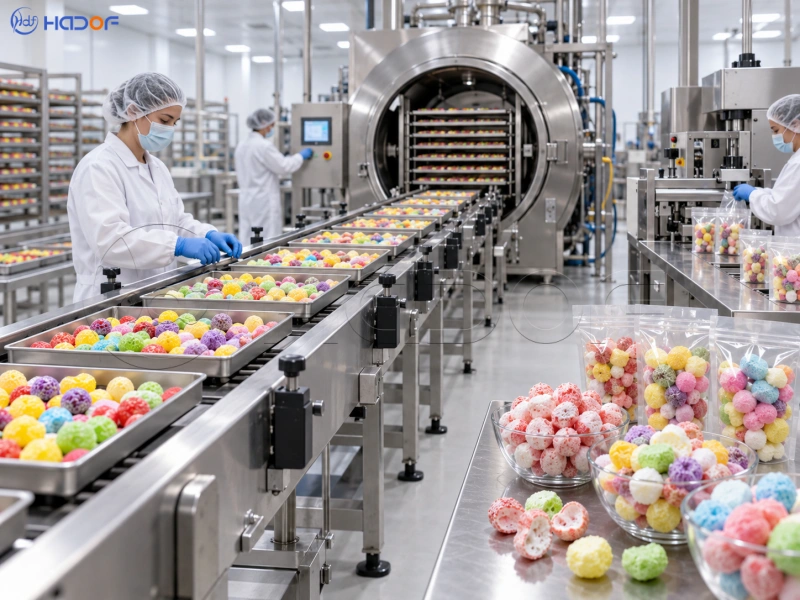
Find the Idle Time First
Candy lines rarely lose hours inside the chamber, because the drying cycle itself runs on a fixed clock. They lose hours before it: tarts and chews wait for tray space, and trays wait for a free chamber. Finished batches also wait for someone to wheel them away. Each wait changes the candy, because sugary surfaces absorb ambient moisture. The piece then puffs unevenly under vacuum, and the crunch turns uneven too. Besides, waiting product picks up floor dust in a busy workshop. Map one full day of production and mark every point where product stands still. Those points, not the drying cycle, usually cap daily output.
Feed the Dryer at a Steady Pace
Uneven feeding forces the chamber into irregular cycles, so the texture pays the price. When trays arrive in bursts, an operator either overloads the dryer or runs it light. Both choices show up in the finished piece as uneven puff and uneven crunch. Therefore, a food conveying machine between preparation and loading keeps trays arriving at a constant rate. Every cycle then starts with the same load shape and the same piece spread. Consistent cycle starts mean consistent vapor loads, and consistent vapor loads protect the puff structure.
Protect the Texture Inside the Cycle
Candy texture depends on how water vapor leaves the sugar matrix, so the cycle settings deserve respect. Rush the cycle and the piece collapses or scorches. Stretch it and the shell toughens while output falls. Therefore, fix one validated cycle per product family and hold it steady. Let the surrounding stations absorb the demand instead of the dryer. An industrial freeze dryer machine sized for your tray plan completes each cycle with full vacuum support. Texture then stays within a narrow band, batch after batch.
Pack Fast, Keep the Crunch
Dried candy is thirsty by nature, so the crunch fades fast in open air. Candy left open on a bench pulls moisture back within minutes. Then the crunch fades before anyone seals the bag. Place the food packing machine near the chamber exit for the shortest transfer distance. Pre-stage packaging materials before each cycle ends, then seal batches while they are still cool. Fast packing protects the mouthfeel and lengthens shelf life at no extra energy cost. Your buyers hear the difference the moment they open the bag.
Grow Output Through a Balanced Freeze-Dried Candy Production Line
Instead, higher output comes from matched stations, not from shortcuts in the cycle. Preparation, loading, drying and packing should run to one clock, while the dryer keeps its validated recipe. Hadof builds freeze-dried candy production lines around your recipe, target volume and workshop layout. Then each station carries its share instead of pushing the dryer past its comfort zone. For a customized candy freeze-drying solution, visit the Hadof freeze dryer homepage at https://www.freezehadof.com/.